Quidah is an online platform that connects investors with curated opportunities and expert insights on Africa’s emerging markets, while offering businesses promotional services, partnership facilitation, and market intelligence to attract capital and grow their operations.
Industries
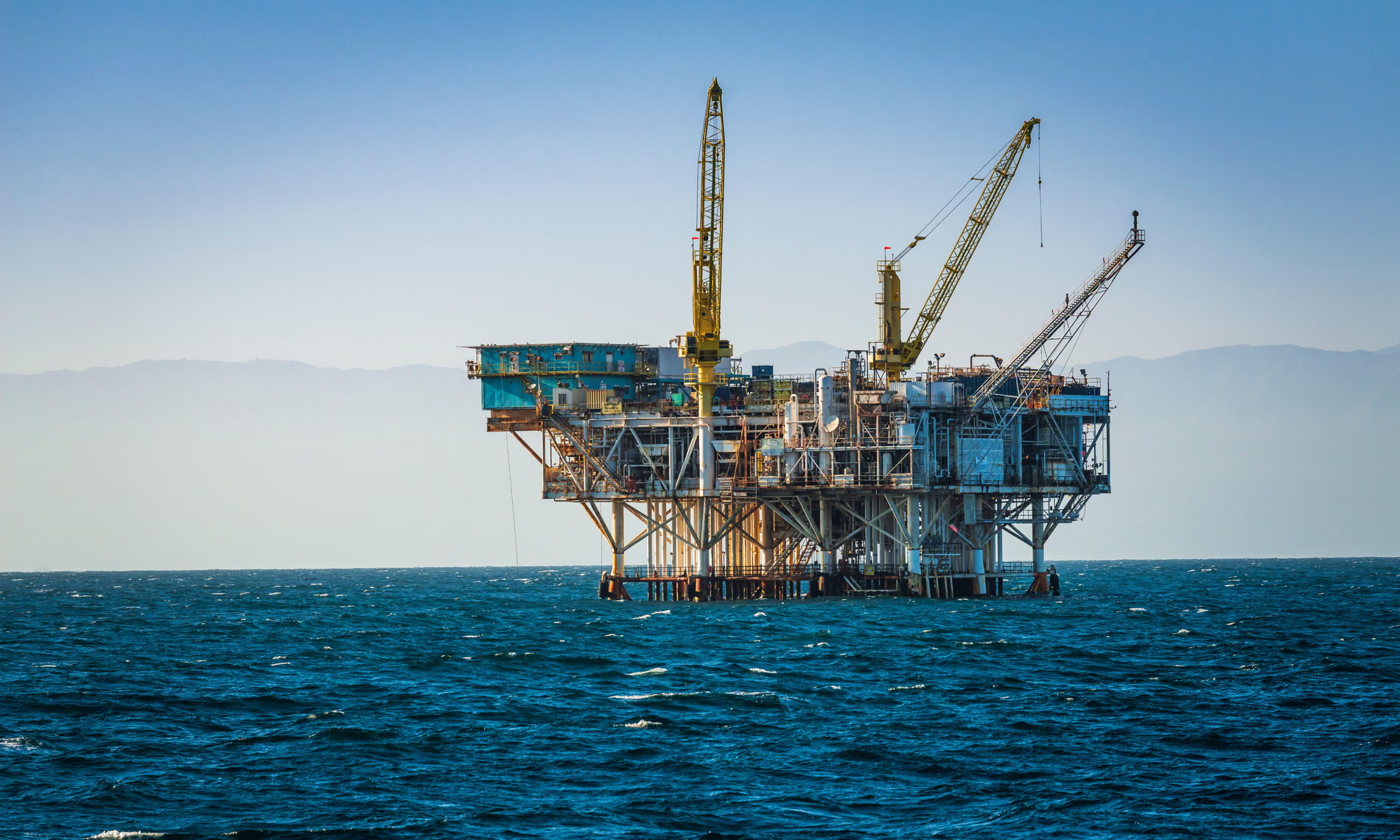
Libya’s oil production has climbed to its highest level since 2013, with crude and condensate output reaching 1,487,723 barrels per day. The latest increase moves the country close to its target of 1.5 million barrels per day.
The production gain strengthens Libya’s position among Africa’s top oil producers and highlights the scale of its reserves, estimated at about 48 billion barrels. That figure makes Libya Africa’s largest proven crude holder, with much of its recoverable oil concentrated in the Sirte and Murzuq basins.
The National Oil Corporation said crude output reached 1,438,560 barrels per day, while condensate production stood at 49,163 barrels per day. The state company said the sector is continuing to recover despite long-running operational and political challenges.
The announcement came during a meeting at NOC headquarters in Tripoli, chaired by Chairman Massoud Sulaiman and attended by board members and senior officials. Sulaiman described the output level as a major achievement and credited workers and technical departments for helping sustain production.
Libya’s recovery has come alongside the return of international oil companies. In February, the NOC awarded exploration blocks to foreign firms in its first licensing round since 2007, with Chevron, Eni, QatarEnergy, Repsol and Türkiye Petrolleri among the winners. Nigeria’s Aiteo also won the Murzuq M1 block.
The awards covered five blocks out of about 20 offered across onshore and offshore areas, including acreage in the Sirte and Murzuq basins. Even so, the limited number of awards showed that investors remain cautious despite renewed interest in Libya’s upstream sector.
The latest output milestone comes more than a decade after Libya entered prolonged instability following the fall of Muammar Gaddafi in 2011. Despite disruptions to fields, terminals and refineries, the country’s oil industry has kept recovering output and drawing fresh foreign interest.
The NOC is also working to restart the 220,000-barrel-per-day Ras Lanuf refinery within a year, after resolving a long-running dispute over the facility. A return to service would strengthen Libya’s downstream sector and help support domestic fuel supply.